Guabancex Prototype
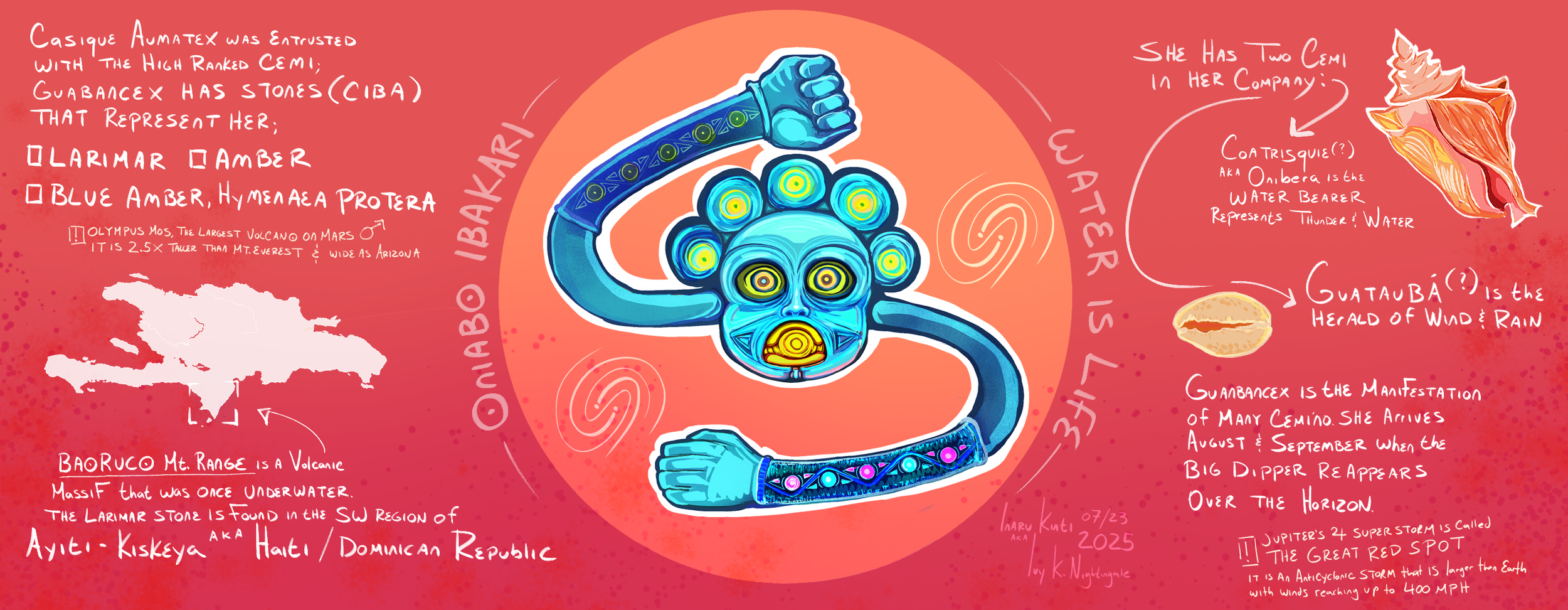
First prototype design of the Guabancex mug by Ivy K. Nightingale
Who is Guabancex?
She is the hurricane manifestation of Mother Earth; Atabey (water) and ItibaKahuBaba (earth) are other manifestations of her. Casike Aumatex (who could have been a historical person, or lore) was entrusted with the High Ranked cemi Guabancex. There are caves (Wakara) in Cuba that have petroglyphs of Guabancex. You can see the hurricane arms in the petroglyphs, and her hands are large like gloves because they are charged with energy.
The two cemi that accompany her are her twin sons,
Guatauba (?) which is represented by thunder and lightning and he is the herald of other cemi’no (ancestors) to produce wind and rain.
The other is Coatrisque, the carrier of water; another name for this ancestor that follows Arawak lexicon is currently known as Onibera, (Oni = Water. Abera = A lot) Onibera is the gatherer of water from the valleys and runs it across the country.
Guabancex and her twin sons operated mainly in the months of August and September when the Big Dipper reappears over the Horizon of the Caribbean Sea. The Big Dipper is a visual metaphor of Casike Anakakuya being pushed off the canoe and into the water. Anakakuya’s name means “Central Star” and we know it as Polaris.
The Big Dipper and Anakakuya lore;
Anakakuya was tricked by his brother-in-law Guahayona. After Guahayona stole all the women from their home cave. Anakakuya set out in a canoe to bring them back. He eventually found Guahayona and the lost women.
While the two men were fishing, Guahayona pointed out a beautiful red seashell called a Cobo at the bottom of the water and persuaded Anakakuya to lean over to the side of the canoe to see it. (I painted a conch shell beneath the big dipper to demonstrate this part of the story) As Anakakuya leaned over, Guahayona shoved him in the water. Anakakuya drowned, and Guahayona was left as the master of the situation. (This is the start of hurricane season) The spiral cross section of the Guamao (conch) is related to the shape of the hurricane.
Robiou-Lamarche related the spiral cross section of the cobo (strombus gigas), to the shape of the hurricane, which is presaged by the sudden hush of frogs. Incised frog objects made of discarded conch shells hold astronomical significance assigned to them via drilled holes, and were likely used as calendar counts. Robiou-Lamarche suggested that the frog shells were used to predict the movements of the constellation, or particular stars, including the Pleiades.
The star cluster Pleiades was known by the Arawak-speaking Baniwa as “Oa” or Toa. Oa is a root word that refers to the star cluster and to frogs. There is a Taino Lore about the starving children that were abandoned by their mothers to follow Gahayona to a separate island.
The orphaned starving children cried “Toa-Toa” as if asking for the teet of their mother. Toa-Toa, or Oa-Oa is a chant to end the dry season. This is tied to the Pleiades and when the star cluster disappears from the evening sky around the end of April, which marks the peak of the wet season. Polaris (Anakakuya) sinks beneath the horizon by late April as well. With the rain there is planting of Yuca and the return of Earthly fertility.
The Queen Conch shell is also known as a Guamo, Cobo, Lambi and a Fotuto, and these mollusks can live up to 10 - 20 years. The conch shell was used as a way of communication across long distances; in some communities this method of communication has been reduced to signal the types of meat being served.
Robiou-Lamarche also considered the use of ground shell powder to activate the hallucinogenic properties of the powdered coho-ba seeds (Piptadenia peregrina) that are typically used by a Behike and a Casike (Medicine-man and Chieftain).
Cohoba should not be confused with Coho-bi which is the actual name of the ‘tobacco plant’ that has been wrongly named. Tabako is the name of the pipe that holds the dried Coho-bi leaves
European Chroniclers used words like Kiskeya and Coatrisque, but these words do not follow the Arawak lexicon. It is very rare for a word to have a consonant follow another consonant.
Who is Sebastián Robiou-Lamarche? He is a Dominican-born historian specializing in Antillean cultures, linking their myths, astronomy, and religion, with extensive publications and founded organizations like Fundación Cultural Educativa and Editorial Punto y Coma. Has authored many books and articles, is involved in academic events, and established cultural groups in Puerto Rico.
He is friends with and speaks to Amanax-Ri, one of the student/teachers that produces thoughtful content; The video the following clip was taken from does mention how the Arawak Lexicon has been incorrect, and that the historian Sebastián Robiou-Lamarche, made an updated dictionary.
https://youtube.com/clip/Ugkx02rAUWAv3m2p4FvdbOe6zdBkkEQW3yYN?si=-wP0FwcXEJugOwwB
CITATIONS;
Ceramic Animal Symbols in the Ancient Antilles by Lawrence Waldron || Atabeyra; 190i, 192, 207 || Guabancex; 191
An Account of the Antiquities of the Indians by Fray Ramon Pane; A New Edition, with Introductory Study, Notes, & Appendixes by Jose Juan Arrom, Translated by Susan C Griswold (( This book is a need to have a reference back to during your studies.))
Fray Ramon Pane was a missionary who created the first book in America written in a European language; An Account of the Antiquities of the Indians. He documented everything he could about the Tainos and Caribs from his perspective during his duration and was given the role to understand the natives of Ayiti.
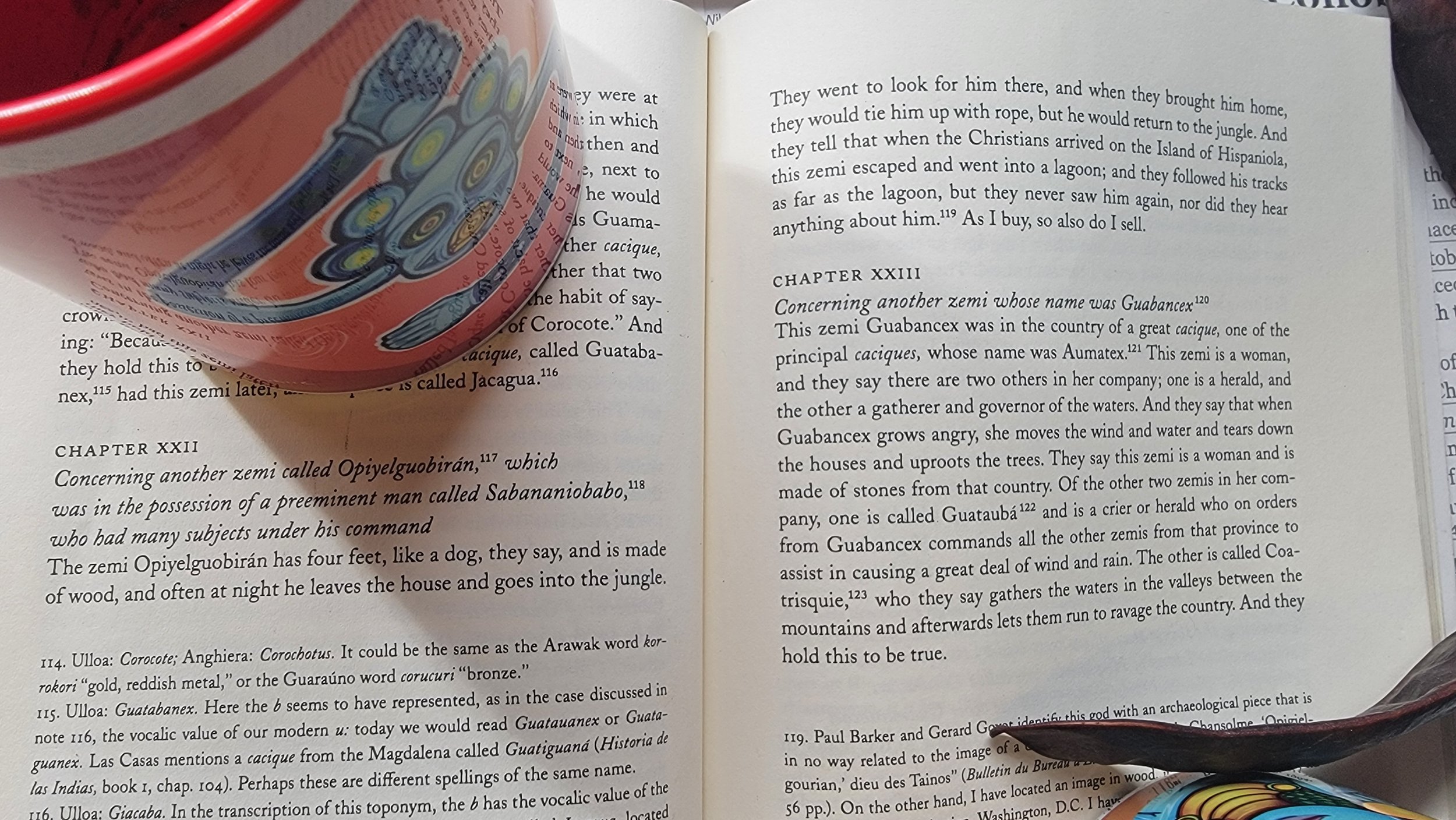
Guabancex Pg 29; Chapter XXIII - Concerning another zemi whose name was Guabancex
This zemi Guabancex was in the country of the great cacique, one of the principle caciques, whose name was Aumatex. (121) This Zemi is a woman, and they say there are two others in her company; one is a herald, and the other a gatherer and governor of waters. And they say when Guanbancex grows angry, she moves the wind and water and tears down the houses and uproots the trees.They say this Zemi is a woman and made of stones from that country. Of the other two zemis in her company, one is called Guatauba (122) and is a crier or herald who on orders from Guabancexcommands all the other zemis from that province to assist in causing a great deal of wind and rain. The other is called Coatrisquie (123), who they say gathers the waters from the valleys between the mountains and afterwards lets them run to ravage the country. And they hold this to be true.
—-
BONUS; Odd ‘typo’ in book?

BONUS; what does the “As I buy, so also do I sell” mean in the following context? (I genuinely don’t know) When you look at the flow of the passage, the last sentence just seems out of place.